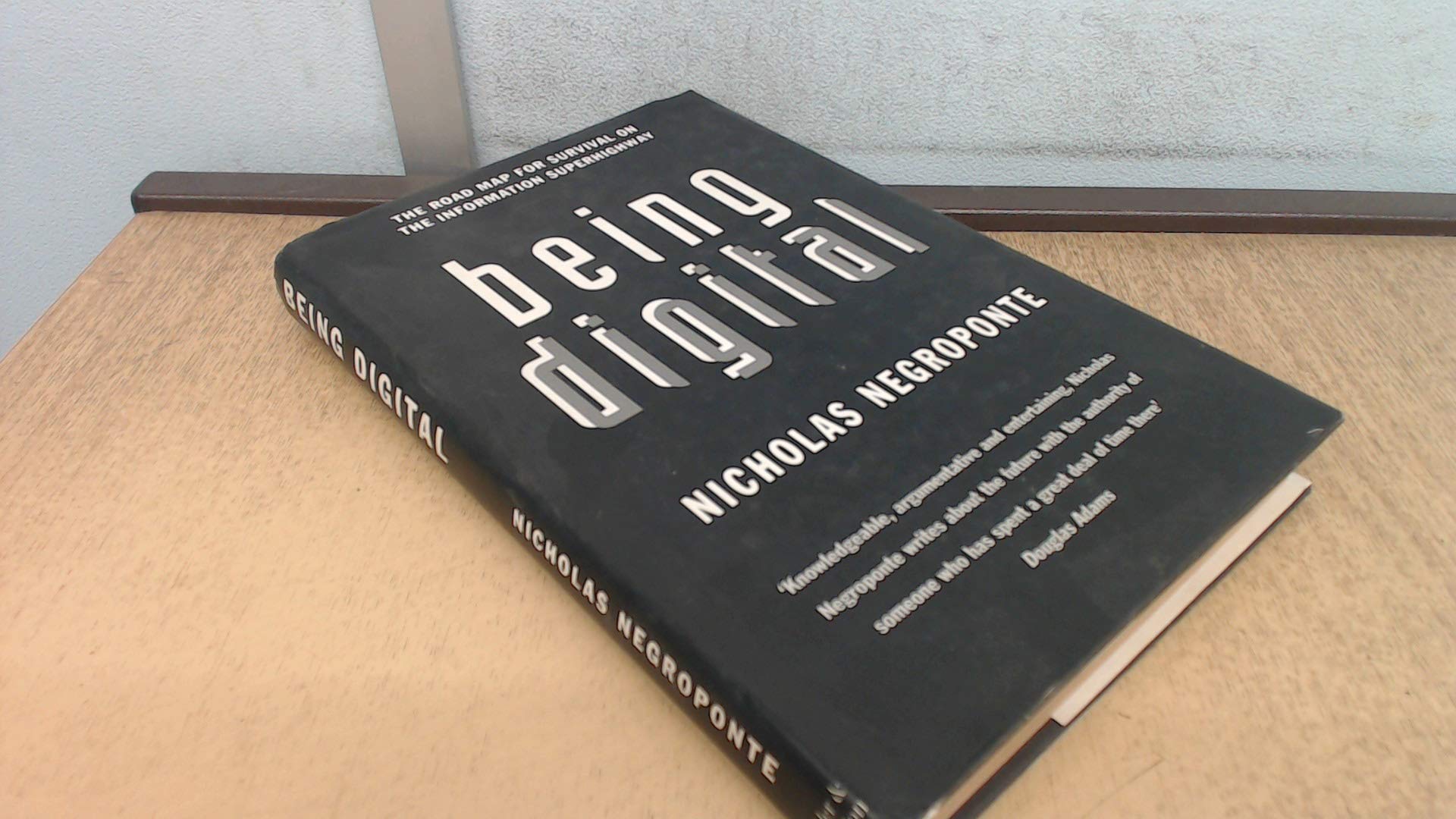
 A number of years ago, shortly after I left high school, or maybe in my first year of uni, I came across this book called Being Digital, written by Nicholas Negroponte, then a columnist at Wired, in 1995. I lived then in Ìbàdàn, Southwest Nigeria, and was still undecided about what I wanted to do with myself. I don’t know whether I saw a copy of the book first, or came across the media frenzy about it. But being at the time already interested in digital technology, I took some interest. In any case, the book was everywhere. I didn’t get far with that first attempt at reading it, though I realized it held something fascinating about the future of technology.
I’d seen a desktop computer perhaps just once before, back then, in the house of a neighbour who ran the private nursery school I had attended. Cable TV was something we’d seen only in the house of another rich neighbour down the street, provided via the huge satellite dish parked in their garden. Mobile phones were not yet a thing in Nigeria, except in the hands of the very rich or the very fraudulent—big, clunky, bulky-looking things, but glamorous all the same. James Bond films showed fascinating new technologies, like self-driving cars and teleconferencing.
I got my first email address in 1998—this I remember. It was a Yahoo email, but in time I also got one on coolmail.com, and another from Hotmail, which seemed like a fancy thing to do. There were others, with names like Eudoramail and Pegasus. In Ìbàdàn in the late 1990s, the only place with public access to the internet was the “Business Centre,” later to be renamed “Cybercafe.” Email at the Business Center was a complicated affair. You wrote your “email” out by hand and handed it to the business center assistant, who typed it for you into the computer, and then sent it on for you via their email server. Almost like a telex system, connecting via “modems” that hooked up to the internet with a whirring tone that sounded like an intubated hospital patient trying to speak. You then went home and returned in a few days to check for a reply to your email. If it had arrived you’d pay for the message, the BC assistant printed it out, stapled it for privacy, and handed it to you.
Within the following year or so it became possible to register a personal email address and send one’s own private emails. But to use the “net,” you paid by the hour for access to one of several computers in the center, which was separated from the one beside you by a wooden bar. The same scene was playing out in Internet cafés from San Diego to Taipei to Mumbai.
For a child of 17, this was a really interesting time. Having access to the computer at all, even if I had to pay for it, was a delight, and it soon consumed all my free time. Eventually, after my admission to the university was delayed by a few months because of a general strike of the Academic Staff Union of Nigerian Universities, I took a job in one of those business centres, as the assistant who typed out other people’s emails and printed their returned replies. I supervised the users who came to “browse” the internet and either renewed their time when it was up or kicked them out. With the job came unlimited access to the exploding new world of the internet. I registered my first website, learnt what cpanel, http, ftp, server, and other mysterious code words meant. I entered the university some months later and had an encounter with one of the earliest of the “Nigerian Prince” scams. But that’s another story.
The influence of Negroponte and his book followed me through my university days almost unconsciously, as I wrestled with linguistics and language technology, and eventually figured myself out as an adult fully invested in the digital life. What was it about the book that had made it such a flavour of the season on its publication?
For one thing, its novelty; Google would not be founded until September of 1998, three years after the publication of Being Digital. I remember the launch of Google as an upstart competitor to the dominant search engines, AskJeeves, Altavista, and Babelfish. If anyone had told me that I would eventually work at Google myself, or that it would become a company that would change the world of maps or the entire field of language technology, I would not have believed it. Even my work in the linguistics degree as an undergraduate touched only briefly on the possibility of “speech synthesis” and “artificial intelligence” and all the coming innovations that, in early 2000s Nigeria, sounded like the tech from the James Bond thrillers.
When the memory of those times came back to me a few weeks ago, I ordered the book, and today, these many years later, I finally finished reading it. I was curious to know how it would seem at this remove, but even more to compare it to the life I’ve lived in the digital technology space over the last three decades.
Being Digital did not disappoint. It made sense that a work of such keen and informed foresight was celebrated at the time, when many of the tools and frameworks we now take for granted, from fiber to deeply archived news sites, were only far-fetched ideas in the minds of the scientists and theorists then envisioning and working toward this new world.
The sense of awe I felt while reading it was matched by the wonder that so many more works of this nature are being written today—some of them, perhaps, equally prescient, and others destined to be wrongly ignored.
***
“Early in the next millennium… your telephone won’t ring indiscriminately; it will receive, sort, and perhaps respond to your incoming calls like a well-trained English butler. Mass media will be defined by systems for transmitting and receiving personalized information and entertainment. Schools will… become more like museums and playgrounds for children to assemble ideas and socialize with other children all over the world… We will socialize in digital neighborhoods in which physical space will be irrelevant and time will play a different role… When you watch an hour of television, it may have been delivered to your home in less than a second.” — Page 6.
“I am more convinced that by the year 2005, Americans will spend more hours on the internet (or whatever it’s called) than watching network television… Computer programs, not just people, will be reading material such as this book and making, for example, automatic summaries. Copyright law says that if you summarize material, that summary is your intellectual property. I doubt that lawmakers ever considered the idea of abstracting being done by an inanimate entry or robo-pirates” — page 58-60
“The information industry will become more of a boutique business. Its marketplace is the global information highway. The customers will be people and their computer agents. Is the digital marketplace real? Yes, but only if the interface between people and their computers improves to the point where talking to your computer is as easy as talking to another human being.” — 85
“The challenge for the next decade is not just to give people bigger screens, better sound quality, and easier-to-use graphical input devices. It is to make computers that know you, learn about your needs, and understand verbal and nonverbal languages. A computer should know the difference between your saying “Kissinger” and “kissing her”, not because it can find the small acoustic difference, but because it can understand the meaning.” — Page 92
“…Personal computers almost never have your finger meet the display, which is quite startling when you consider that the human finger is a pointing device you don’t have to pick up, and you have ten of them. You can move gracefully from typing to pointing, from horizontal plane to vertical. Yet it hasn’t caught on…” Page 132
“For most people, typing is not an ideal interface. If we could speak to our computers, even the most confirmed Luddite would use them more enthusiastically. Nonetheless, computers remain more and less deaf and mute. Why? The primary reason for so few advances in speech recognition is lack of perspective, not lack of technology… We don’t want to talk to a computer like a tourist addressing a foreign child, deliberately mouthing each word and pausing after it.” 137-141.
“A future agent is often seen as some centralized and omniscient machine of Orwellian character. A much more likely outcome is a collection of computer programs and personal appliances, each of which is pretty good at one thing and very good at communicating with the others. The image is fashioned after Minsky’s The Society of Mind (1987), in which he proposes that intelligence is not found in some central processor but in the collective behavior of a large group of more special-purpose, highly interconnected machines.” — 157
“In future digital media there will be more pay-per-view, not just on an all-or-nothing basis, but more like newspapers and magazines, where you share the cost with advertisers. In some cases, the consumer may have an option to receive material without advertising but at a higher cost. In other cases, the advertising will be so personalized that it is indistinguishable from news. It is news.” — page 170
“I don’t know about you, but I would throw away my VCR tomorrow for a better scheme… With all due respect to Blockbuster and its new owner, Viacom, I think videocassette-rental stores will go out of business in less than ten years.” — Page 173
“The next decade will see cases of intellectual property abuse and invasion of our privacy. We will experience digital vandalism, software piracy, and data thievery. Worst of all, we will witness the loss of many jobs to wholly automated systems, which will soon change the white-collar workplace to the same degree that it has already transformed the factory floor. The notion of lifetime employment at one job has already started to disappear…” — page 227
I’ll stop here, because I want you to read it, and wonder with me how much of this book may have influenced the countless visionaries, famous or obscure, whose innovations we now depend on for basic navigation of everyday life, from Netflix to Zoom, and how many more of his predictions—like a home service robot that barks like a dog when it senses an intruder—have yet to come to pass. The book, almost surprisingly, didn’t envisage crypto.
***
Personal computers, like the internet, have become commonplace in Nigeria. To my pre-teenage son living in America today, descriptions of the internet of my youth will sound like a fairytale. But many of the issues we grapple with today in Nigeria and on the African continent still have to do with whether our best technologies will ultimately succeed in improving society, or preventing underdevelopment.
My job, as it has evolved over the years, has been to find ways to make the new digital world recognise peculiar characteristics of that society, especially from the language angle. We have Google Maps now in Nigerian English—a project I led; I’ve also participated in many other projects to make language technologies function well in African languages. This includes the foundational work of digital lexicography, including building platforms like YorubaName.com and ttsyoruba.com, curating data for machine learning, and improving support for diacritics. None of this is happening as quickly as needed, but it is way better than what used to be. Digital globalisation, the dream of Negroponte’s generation, has in many ways come to pass, but it came with deep cracks that still prevent global equitable access.
I have since learnt that the Being Digital came from the the author’s regular columns in Wired magazine, and that it has now been translated into over forty languages. It must delight him to know that his words still comprise a relevant collection of data that can be bought online, as he imagined, through a digital shopping cart, and read on exactly the kinds of devices he dreamed of more than thirty years ago.
[First published on June 11, 2026 on FlamingHydra.]